I saw this movie awhile back and had forgotten about it until recently, when I saw Dax Shepard in another film. I found this movie to be fucking hilarious! If you like gallows humor that is slice-and-dice funny, no pun intended, then you need to take a look at "Let's Go to Prison". Do not expect a formulaic film; you never know what's going to happen next. The cast is top notch all the way. Words escape me in doing a description justice, again no pun intended, so I found a review that does a good job of it. It follows:The Prison Movie with a Shank, Not an AxeBy NEIL GENZLINGER of The New York TimesPublished: November 18, 2006The movie’s called “Let’s Go to Prison,” and its poster consists of a close-up of a bar of soap in a shower, so of course you’re expecting a crass, brainless film, a frat house behind bars. It takes a while to realize that this is actually a sly, very funny comedy, one that stays admirably deadpan every time you think it’s about to veer into gross-out territory. Not that it forgoes a shower scene; there are several. But the director, Bob Odenkirk, and the writers — Ben Garant, Thomas Lennon and Michael Patrick Jann — all have plenty of comedy on their résumés, and they seem to have learned that restraint is funnier than excess. The camera operators too: there is much showering but little forbidden flesh.
Dax Shepard, in both his acting and his voice-over, is wonderfully droll as John, a petty criminal who is peeved at the judge who kept putting him away. By way of retaliation, he helps nudge the judge’s son, the tightly wound Nelson Biederman IV (Will Arnett), into prison, then purposely has himself arrested so he can join him there. His plan is to make Nelson’s life miserable, and for a while he does, but of course things ultimately take an unexpected turn. More important, Mr. Shepard and Mr. Arnett, though playing polar opposites and mortal enemies, make a dandy comic duo.
The prize, however, goes to Chi McBride as a large fellow who leads the prison’s black gang and has a taste for Chuck Mangione‘s music and prison-style lovin’. His character’s name is Barry, and if that suggests a certain dim-the-lights soul singer, it’s no accident; this is a jailhouse thug of a decidedly different sort.
In fact, the whole movie is that way: it serves up the characters and situations you’d expect from a prison comedy but then plays them with wry understatement. All such comedies, for instance, must have dining hall humor, usually ending in a food fight, but this one delivers its version in a tidy five words. When Nelson asks an orderly what it is that he’s dishing up, the man says simply: “That’s meat; that ain’t meat.”
“Let’s Go to Prison,” which draws on the book “You Are Going to Prison” by Jim Hogshire, ultimately has to resort to an old and unconvincing gimmick to resolve its story. For most of the way, though, it adheres to the description that the prison warden (Dylan Baker, very amusing in a small role) gives of himself after delivering a scatology-inflected welcoming address to arriving inmates. “I have,” he says, “a notoriously dry sense of humor.”
“Let’s Go to Prison” is rated R (Under 17 requires accompanying parent or adult guardian), mostly for language.
Directed by Bob Odenkirk; written by Robert Ben Garant, Thomas Lennon and Michael Patrick Jann, based on the book “You Are Going to Prison” by Jim Hogshire; director of photography, Ramsey Nickell; produced by Marc Abraham, Matt Berenson and Paul Young; released by Universal Pictures. Running time: 84 minutes.
WITH: Dax Shepard (John Lyshitski), Will Arnett (Nelson Biederman IV), Dylan Baker (Warden) and Chi McBride (Barry).
Labels: black comedy, film, prison
The Wrestler

 Saw it today. This is more than acting, folks. This is a story of Mickey Rourke in Hollywood formatting.
I can't imagine ANYONE else playing the role of The Wrestler.
Marisa Tomei is sizzling hot as a stripper and is a damned fine actress too.
The film is an excellent parallell study on Rourke and Tomei's characters. I liked the concise and cohesive nature of the plot. I'd like to see the director taking a non-linear approach in future endeavors.
I love this movie. Hoping to see more Mickey Rourke in films. Directors and Producers, open your eyes people! He has more talent in his scars than most folks have in an entire acting career. The photographer of the second photo needs to be kissed.Labels: film, mickey rourke
Nim's Island
 A friend and I went to see Nim's Island last night. When I read the plot synopsis a few days ago, I thought the plot sounded pretty good. I wasn't disappointed. What strikes me most about this film are a couple of things. One is that it is 100% wholesome! There's no sex, gratuitous violence or nudity, and significantly there isn't a mean bone in the body of this film. How can this be!? The closest thing to ill-will was the portrayal of the passengers on a cruise ship, but even then, was it a slam or an accurate portrayal. I would like to think it was good-natured fun and an attempt at throwing more humor into the film.
Not that there isn't light-heartedness galore in the first part. The critters are several, and they are not anthropomorphized as much as they are given distinct personalities that include empathy.
The little girl in the film runs the show as far as screen presence. When she's around, your eyes are on her. Abigail Breslin was the girl in the film, "Little Miss Sunshine", and she's as cute now as she was then. It's something to see how well she covers a wide range of emotions. The thing I think I like best about her is her competence.
The dad/hero in the movie, Gerard Butler, looked familiar throughout the film, but I couldn't quite place him. Boy was I surprised when I looked him up on imdb.com and discovered that he was the dude with the big white teeth in "300"! He is more life-like in "Nim's Island", but still larger than life in my view. What really impresses me about his character is that he's an outstanding parent and that he is a MacGuyver kinda guy. Anybody who likes to see what good modeling for a parent looks like and who is into gadgets will LOVE this movie. Don't worry, neither is over the top.
Now we come to Jodi Foster. She isn't the little girl in Taxi Driver anymore, but she continues to give solid performance. It's good to see her up on the screen again.
The messages in the film are that girls can be competent, fears can be overcome, and curiosity is a good thing. There are lots of other, more subtle messages as well.
This is a film that many adults will enjoy, and I can't think of any kid over the age of 6 that wouldn't enjoy it. Check it out.
Labels: adventure, children's, film
Dom durakov or House of Fools (2002)
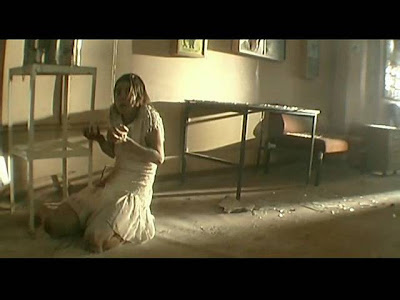 Russian film, in Russian, with English subtitles.From the blurb on the netflix jacket cover:"A true story about the patients of a Russian psychiatric asylum (In Caucasus, on the Chechnyan border) who become involved with the Chechen War after their doctors, nurses and attendants abandon them. Amidst the turmoil, a young woman, Janna, falls in love with a Chechen soldier. Canadian pop singer Bryan Adams (playing himself) appears to Janna as a hallucination singing his hit, "Have You Ever Really Loved a Woman?"Now if that plot doesn't pique your interest I don't know what would. The abandonment really isn't an abandonment, and the love story isn't what you might think. Bryan Adams is magic. All will be revealed once you take a look at this endearing portrayal of human behavior in "unusual" circumstances. From Roger Ebert's take: "A film that succeeds not by arguing that the world is crazier than the asylum, but by arriving at the melancholy possibility that both are equally insane."I don't know how melancholy the movie is. Despite the grim circumstances the human spirit shines. Leave out the word melancholy from Ebert's assessment and call it good.
 Labels: asylum, fantasy, film, humanity, war
Solaris 1972 Version
 I just finished watching this netflix arrival. Thinking I was choosing the more recent version with George Clooney, it was with uncertainty that the play button was pushed. The Clooney version is one older son really likes, but the time I watched it a few years back, it didn't make a huge amount of sense or much impact on me. This viewing was to see if it did more in both arenas this time around.
After sitting there enraptured for 169 minutes -- yes 169 minutes -- without serious consideration of a bathroom break, you may have some idea that this version may be a tad more substantial than the maudlin sap I remember from from the later version.
What can I say without giving away too much? The movie begins out in the country, with some of the most stunning nature shots I've ever seen in a film that didn't involve stuff taken from planes or helicopters. Woodlands and water shots exquisite enough to make you cry. Any one of the freeze frames could be framed and hung on a wall. These scenes alone are worth seeing the movie for. Seriously!
The man walking through the woods is leaving the next morning for outer space, to a space station in orbit around a planet that I think must be called Solaris. The focus of the planet is its ocean. The man is not an astronaut. He's a psychologist. He is investigating the few men remaining on the space station and the phenomenon described by one of the astronauts who came back from the place years ago.
This is where any more of the plot being revealed ends. Hopefully it's enough to pique your interest. OK one more thing. This film will appeal to thinking and philosophizing minds, and the questions asked will get you to doing critical thinking right along with the characters.
That said, Solaris rates up there in the must see at least once and probably more category.
Labels: 1972, film, foreign, philosophy, science fiction
No Country for Old Men
 I wasn't sure what to expect with this movie. All I heard was it had Tommy Lee Jones in it and was about a cowboy. When a friend mentioned she wanted to see it I took a quick gander at a plot summary that didn't give away any secrets. I had seen no trailers. You'd be better off not doing either either.
Tommy Lee Jones plays a small but powerful role. Woody Harrelson is exceptional. There are two real stars in this movie, but they aren't the two illustrious names above. I refuse to give away any of the plot, but Josh Brolin and Javier Bardem each have stage presence that unequivocally portend their presence upon many more screens in the future. Mark my words!
If you've seen any Coen brothers' directed movies you know that they can be ...... intense. This one is no exception. The plot twists and turns like a dragonfly on a hot day, and it is with delicious anticipation that one sits in their seat wondering what's going to happen next. Stay away from this movie if you're not into graphic violence.
There is a philosophical aspect to the movie that I chose not to explore on my first viewing of it. It is a film I hope to see at least a few more times.
Labels: coen brothers, film, thriller
Sweeney Todd

I won't go into the details of the plot of Sweeney Todd. You can find that anywhere out on the 'net and probably already know it without even googling.
A few words about Tim Burton's production of what has been performed as live theatrical performance up until now (as far as I know there hasn't been a movie made of it previously). Fans of Burton's admirable ability to capture a tragic hero's quest for finding a niche in a cruel world -- a world that has no understanding, and less tolerance, for misfits -- will not be disappointed in Sweeney Todd.
Where there is a possibility that live performers have captured the torment of Sweeney, it is certain that Johnny Depp succeeds. He exudes torment. He is a man driven. Obsessed even. He brings Sweeney, a man who is, in all spiritual respects a walking corpse, to life. He's a man who has been driven to madness by the cruelty of human nature turned against him, yet manages to keep enough wits about himself to wreak a considerable amount of payback.
The rest of the cast shows no flaw. A short but sweet cameo by Sasha Baron Cohen, is the only splash of color other than red in the dreariness of the geographical and human landscape. The young lad who gets drawn into the madness looks like he will have an acting career ahead of him. Helena Bonham Carter, Tim Burton's long-term partner, has nailed her role as the consummately common baker of meat pies, expert roach smasher, and unrequited lover. Alan Rickman plays the perverse villain with his usual flair. I like the closeups of his face, which is gathering even more character, believe it or not, as he ages. His loyal, sneering manservant (sorry his name escapes me, but he plays a similar minion in Enchanted) adds his talents to the mix. The naives playing the roles of sailor and ward are sweet and innocent pawns unwittingly drawn in as well.
Expect lots of blood and some rather graphic violence as the bodies hit the floor.
Expect to be surprised by the pleasant sounds of Depp and Bonham-Carter's voices.
Labels: film, Johnny Depp, Tim Burton
 Click on the title to take you to the rest of the following introduction to the movie's plot:
 The film begins with author Rudyard Kipling (Christopher Plummer) working in his office, his privacy is broken by the arrival of a dishevelled old acquaintance and fellow Freemason, Peachy Carnahan (Michael Caine), Peachy begins to recount the incredible adventures of himself and fellow scoundrel Daniel Dravot (Sean Connery). The film then flashes back to an earlier meeting between Kipling, Peachy and Daniel, Kipling is asked to witness a document testifying to what they have told him of their plans.
The two rogue adventurers were British soldiers stationed in India, but were expelled from the country due to their criminal activities. Together they decide to travel to the remote city of Kafiristan in the hills of eastern Afghanistan to set themselves up as rulers. The two endure all the hardships of mountain trekking and severe weather before reaching the glorious valley and it’s remote city.
This is where things really begin to get interesting. The movie was made in 1975. It's something to see Michael Caine and Sean Connery, two consummate actors who exude masculine animal magnetism even at old men today, as young, virile men in their prime. Ooh la la. And the chemistry made between these two as they play off of each other leads me to believe that they should have made a lot more movies together. They click like Robert Redford and Paul Newman clicked in Butch Cassidy and the Sundance Kid and The Sting.
The story is an intriguing one, where you can sense a great adventure getting ready to begin. It's based upon a short story by Rudyard Kipling. According to one reviewer at http://imdb.com, the mythical kingdom is not mythical at all. Doesn't that make it even more intriguing.
Having John Huston (Anjelica's dad) as director, how can one go wrong?
Go to: http://us.imdb.com/title/tt0073341/trivia for some interesting trivia on the movie.
Labels: 1975, adventure, film, John Huston
Curse of the Golden Flower / review by Jeremy C. Fox
 Douglas Sirk Rises from Dead, Directs Wuxia
 Curse of the Golden Flower / Jeremy C. Fox
Set in 928 A.D., at the tail-end of the Tang Dynasty, Zhang Yimou’s Curse of the Golden Flower takes place largely inside the imperial palace, where all conduct is strictly regulated by the court’s elaborate system of rules and customs. The empress cannot walk from one room to another without a phalanx of attendants, nor must she ever open or close a door for herself, and even her own sons must bow and greet her as “your majesty.” Human nature being what it is, though, this strict adherence to ceremony and deference to authority is no more than a façade; when they think no one is looking, both the imperial family and some of the cheekier members of the court engage in the sort of behavior that would make your grandmother choke on her ribbon candy.
The film’s plot is based on the incendiary 1934 play Thunderstorm by Cao Yu, one of the founders of modern Chinese theater, but Zhang’s transposition of the action seeks to give the film a grand, mythic resonance, with echoes of Hamlet, King Lear, and Sophocles. Zhang has said that his central theme derives from the old Chinese saying “Gold and jade on the outside, rot and decay on the inside” — the beauty of the court is only a mask for its treachery and dissolution. As the film opens, the empress (Gong Li, working with Zhang for the first time in over a decade, following the breakup of their personal relationship) is awaiting the return of the emperor (Chow Yun-Fat) from a military campaign. Things haven’t been quiet in the palace during his absence; the empress’ lover and stepson, Crown Prince Wan (Liu Ye) has ended their liaison, to her disappointment, and has taken up with the daughter of the imperial doctor, Chan (Li Man). He longs to flee the palace for a quiet, provincial life with his lover, though both his obligations and his family’s hidden secrets will inevitably make his dream impossible. The empress, aware that she’s being slowly poisoned by the imperial doctor (Ni Dahong), has begun plotting a way out of her situation, and she calls upon her older son, Prince Jai (popular Taiwanese singer Jay Chou), for help. Prince Jai exemplifies the Chinese value called xiao — unconditional love, loyalty, and respect for a parent — but his xiao applies only to his mother. His relationship with his father is contentious — the emperor declares that he will give Jai many things, but what he doesn’t give must never be taken by force, but Jai is not a man to wait meekly for his father’s beneficence. And his younger brother, Prince Yu (Qin Junjie), still a few years shy of shaving, is precociously power-hungry, while the imperial doctor’s wife (Chen Jin) is interested in undermining the emperor for secret reasons of her own.
Zhang takes his time laying out these relationships and allowing the conflicts to bubble to the top, and the first half of the film is almost devoid of action scenes. What we get instead are sumptuously gorgeous visuals, as both the characters and the palace are tarted up in the most extravagant finery. With a budget of $45 million, Curse of the Golden Flower is the most expensive Chinese film to date, and the money is all onscreen — in the palace, a reproduction of the Forbidden City adapted to Tang Dynasty architectural style, which is the largest set in Chinese film history, and in Yee Chung Man’s decadently elaborate costumes, a combination of Tang Dynasty and French Empire. Those familiar with Zhang’s use of color in his earlier films will not be surprised by its richness here, yet it’s impossible not to be impressed by extravagant lengths his crew has gone to, creating decorative glass pillars that radiate multicolored light and filling the palace’s courtyard with close to a million flowers for the film’s climactic chrysanthemum festival. Everything about it is gorgeously over the top, much like the family melodrama that occasions it.
The problem is that the melodrama never quite reaches the necessary boiling point. Zhang takes so long to establish the complexities of the court and gives us so few characters to care about — essentially just the empress and Prince Jai — that much of the film seems like unnecessary time spent with characters we’d just as soon not get to know so well. The performances are uniformly strong — though certainly Gong and Chow outshine their younger co-stars — but how many times can we see the emperor demonstrate his absolute power without it getting tired? And the shakeup we come to expect doesn’t quite work out as we’d hoped.
There’s a lot in Curse that does work — the familial conflict, the complex layers of hidden truths, and certainly the beautiful cinematography by Zhao Xiaoding — but it never comes together in a way that’s fully satisfying. We see what Zhang is saying about the way lies and secrets can tear a family apart and how expedient choices can come back to haunt us, but the film’s action never quite justifies its scale, so that we’re left with a presumptive epic that is ultimately too narratively limited to qualify for the form. Zhang is reaching for Shakespeare but getting no further than Douglas Sirk.
Jeremy C. Fox is the managing editor of Pajiba and a member of the Online Film Critics Society. You may email him at jeremycfox[at]gmail.com.Don't let the fact that the movie has a less than "perfect!" assessment by this critic stop you from going to see it. It's well worth seeing on the big screen.
Labels: asian, chow yun fat, film, gong li


